Benefits of Ceramic Coating for Cars – Guide for Southwest Oklahoma Drivers
What ceramic coating actually does, what it doesn’t, and why the climate in Altus, Elgin, and Lawton makes it one of the more practical upgrades you can make for your paint.
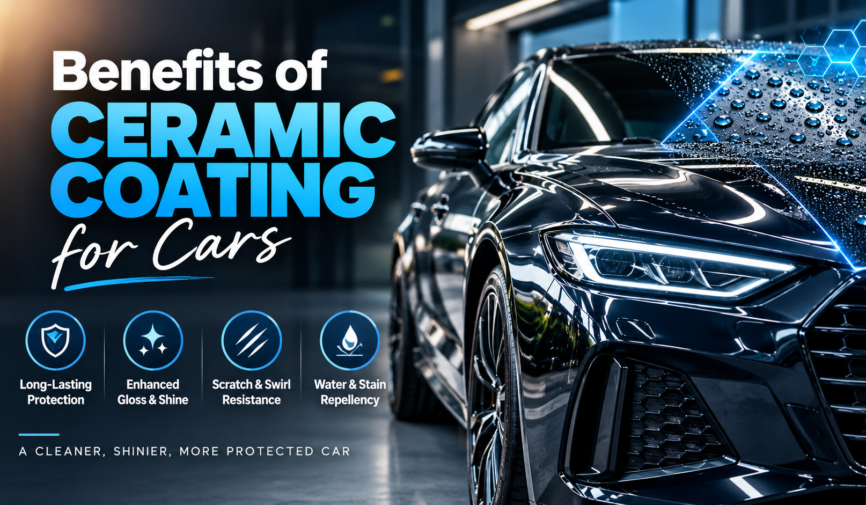
The Real Benefits of Ceramic Coating for Cars
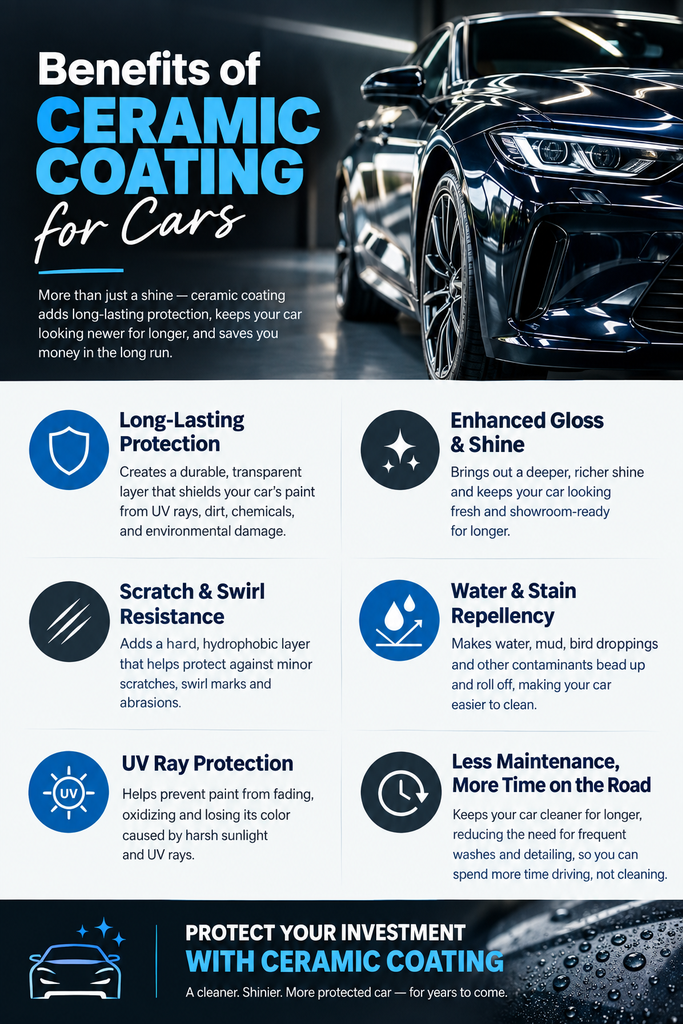
1. UV Protection Against Fading and Oxidation
Sunlight specifically UV radiation is the single biggest long-term threat to car paint. Over years, UV exposure breaks down the resin in clear coat, leading to fading, chalky oxidation, and loss of that “wet” gloss look. The SiO2/TiO2 layer in ceramic coating physically blocks a significant portion of UV radiation before it reaches the paint underneath a big deal in a region where cars sit outside in strong sun for most of the year.
2. Hydrophobic Water Repellency
Ceramic coating creates an extremely high water “contact angle,” meaning water beads up tightly and rolls off instead of sheeting across the surface. This reduces water spotting from mineral deposits and carries dirt and grime away every time it rains or you rinse the car less scrubbing, and less risk of swirl marks from washing.
3. Resistance to Bugs, Tar, Sap, and Bird Droppings
These contaminants are acidic or sticky enough to etch into unprotected clear coat, especially when baked on by heat before you get a chance to wash them off. A cured ceramic layer prevents them from bonding directly to the paint, so they wipe away instead of eating in.
4. Light Scratch and Swirl-Mark Resistance
Because the cured coating is significantly harder than bare clear coat, it holds up better against fine marring from wind-blown grit, automatic car-wash brushes, and improper drying. It will not stop a deep scratch or rock chip, but it meaningfully reduces fine “spider-web” swirls over time.
5. Enhanced Gloss and Color Depth
Because the coating levels out at the microscopic level and reflects light more uniformly than bare or oxidized paint, most owners notice a genuine increase in gloss and depth a “wet look” that outlasts a wax job by years, not weeks.
6. Easier, Faster Washing (Real Time Savings)
Because contaminants don’t bond as aggressively and water sheets off, washing a ceramic-coated car generally takes less time and less product a measurable reduction in maintenance effort over the life of the coating.
7. Long-Term Paint Preservation and Resale Value
Paint condition is one of the first things a buyer or appraiser notices. A vehicle protected from oxidation, etching, and swirl marks for several years will generally present and often appraise better than a comparable vehicle with sun-faded or heavily swirled paint.
What Ceramic Coating Actually Is
Ceramic coating is a liquid polymer, most commonly based on silicon dioxide (SiO2), sometimes paired with titanium dioxide (TiO2) or zirconium oxide for added UV-blocking and corrosion resistance. When it’s applied and cured, it doesn’t just sit on top of your paint the way wax does it forms a thin, semi-permanent layer that chemically bonds to the clear coat, filling microscopic pores and creating a smooth, hard, glass-like surface.
Most professional-grade coatings cure to a hardness of roughly 7H to 9H on the pencil hardness scale (for reference, that’s harder than factory clear coat, but well short of a diamond). That hardness is what gives ceramic coating its resistance to light scratching, chemical etching, and UV degradation and it’s why the effect lasts years rather than weeks, unlike wax.
Honest framing: Ceramic coating is a paint protection product, not a paint restoration or armor product. It works best on paint that’s already been properly washed, decontaminated, and corrected.
Why It Matters More in Altus, Elgin & Lawton, Oklahoma
Ceramic coating isn’t equally valuable everywhere its benefits line up with specific climate stressors, and southwest Oklahoma has more than its share of them.
| ~3,250 hrs Average annual sunshine, Lawton area | ~21 days/yr SW Oklahoma summer days ≥100°F | UV Index 7 Average daily peak, June–August |
| 120°F Record high, Jackson Co. (Altus), 1936 | 31.6 in Average annual precipitation | 78+ mornings Average mornings/yr at or below freezing |
Intense, Long-Duration UV Exposure
Lawton and Altus both sit in a part of Oklahoma that logs well over 3,000 hours of sunshine a year, with clear-sky conditions occurring roughly 80% of the time in peak summer. Combined with a daily UV index that regularly peaks at 7 (high) from June through August, that’s sustained, high-intensity UV exposure on any vehicle parked outside exactly the condition ceramic coating’s UV-blocking layer is designed to counter. Elgin, about ten miles from Lawton in Comanche County, sits in essentially the same climate zone.
Extreme Summer Heat
Southwest Oklahoma averages around 21 days a year at or above 100°F, and Altus holds a state-level record high of 120°F set in 1936. Heat accelerates almost every form of paint degradation: it bakes on bug splatter and tar before you can wash it off, speeds up UV-driven clear coat breakdown, and makes waxes (with their low melting points) far less durable than a heat-stable ceramic layer.
Hail and Severe Spring Storms
Jackson County (Altus) has a documented history of hail events in the 0.88″ to 1.25″+ range, and the broader Lawton/Comanche County area sits in a corridor prone to severe spring weather, including a historic F4 tornado near Lawton in 1957.
Honest framing: Ceramic coating in lawton will not prevent hail dents nothing short of paint protection film or physical cover does that. It reduces the etching and fine scratching that often follow a hailstorm, and keeps the surface cleaner going into paintless dent repair.
Wind-Blown Dust and Red Dirt
The region’s agricultural land and periodic dry, windy conditions mean cars regularly accumulate fine, abrasive dust a leading cause of swirl marks when it grinds into clear coat during washing. A hydrophobic ceramic surface lets dust rinse off more easily before you ever pick up a wash mitt.
Ceramic Coating vs. Wax vs. Paint Sealant
| Carnauba Wax | Paint Sealant | Ceramic Coating | |
| Typical lifespan | 4–8 weeks | 3–6 months | 2–5+ years (pro) |
| Bond type | Sits on top | Sits on top | Chemically bonds |
| UV resistance | Low | Moderate | High |
| Heat stability | Low (can melt) | Moderate | High |
| Hydrophobic effect | Moderate | Moderate | Strong, long-lasting |
| Scratch resistance | None | Minimal | Moderate (surface-level) |
| Upfront cost | Low | Low–moderate | Moderate–high |
The honest takeaway: wax and sealant are cheaper and fine for short-term shine, but in a climate with this much sun and heat, they need reapplication so often that ceramic coating’s higher upfront cost tends to even out or come out ahead over a few years.
What Ceramic Coating Will NOT Do
Trustworthy content means telling you what a product can’t do, too. These are the most common overclaims in this industry:
- It is not “scratch-proof.” It resists fine swirl marks; it will not stop keys, deep gouges, or careless washing.
- It does not stop rock chips or hail dents. Those are impact damage, not surface wear that’s what paint protection film (PPF) and physical shelter are for.
- It is not permanent. Even long-lasting professional coatings wear down over years of UV exposure and washing and need reapplication or a maintenance top-coat.
- It does not eliminate the need to wash your car. It makes washing faster and safer for the paint it doesn’t replace it.
- A hardness rating above 9H on a spray bottle is a red flag, not a bonus. That level of hardness is close to diamond and typically isn’t realistic or stable for a flexible automotive coating.
Maintenance and Realistic Lifespan
- Curing: Most professional coatings need 24–72 hours to cure and should stay dry during that window plan drop-off around Oklahoma’s unpredictable spring storm pattern.
- Washing: Hand wash with a pH-neutral shampoo and the two-bucket method every 1–2 weeks; avoid automatic brush washes.
- Decontamination: Given the region’s bug activity and road tar, periodic clay bar or chemical decontamination helps the coating keep performing.
- Boosting: A hydrophobic spray “booster” every few months extends gloss and slickness between full reapplications.
- Reapplication: Plan on 2–5 years for professional multi-layer coatings, depending on product tier and outdoor sun exposure.
What It Costs, and Why Prices Vary
Professional ceramic coating pricing depends heavily on vehicle size and condition, the number of coating layers, whether paint correction is included first, and the product tier used so treat any number you see online as a rough starting point, not a quote. As a general market range, DIY consumer sprays run from roughly $20–$100 in product cost, while professionally applied multi-year coatings commonly range from a few hundred dollars up to $1,500–$2,500+ for larger vehicles or premium multi-year packages that include full paint correction. The only way to get an accurate number for your vehicle is a direct inspection and quote
Bottom line for Altus, Elgin, and Lawton drivers:
This is a climate that stresses paint through nearly every mechanism ceramic coating is built to address intense UV, sustained heat, baked-on contaminants, wind-blown dust, and occasional hail and freeze-thaw cycling. It’s not a magic shield, but applied with realistic expectations, it’s one of the more genuinely useful upgrades for anyone keeping a vehicle outdoors here for the long haul.
Frequently Asked Questions
Q: How long does ceramic coating actually last on a car?
A: DIY sprays and sealants typically last 3 to 12 months. Professionally applied, multi-layer ceramic coatings generally last 2 to 5 years, and some premium silicon-carbide (SiC) formulas are rated 5 to 10+ years, depending on the product, prep, and how the car is maintained and stored.
Q: Does ceramic coating prevent scratches and rock chips?
A: No. It resists fine swirl marks and light marring thanks to its 7H–9H hardness, but it will not stop rock chips, deep key scratches, or hail dents. Paint protection film (PPF) is the correct product for that level of protection, and it’s often layered with ceramic coating.
Q: Is ceramic coating worth it in a hot, sunny climate like southwest Oklahoma?
A: In most cases, yes. The Lawton/Altus area logs roughly 3,200+ hours of sunshine a year and around 21 days above 100°F each summer — conditions that accelerate UV oxidation, fading, and baked-on contaminants. Ceramic coating’s UV-blocking, hydrophobic layer directly addresses those specific stressors.
Q: Can ceramic coating protect a car from hail damage?
A: No. It cannot prevent dents, and hail is a documented risk in Jackson and Comanche County, Oklahoma. It can reduce clear-coat etching and scratching around a hail event and keeps the surface cleaner for paintless dent repair afterward.
Q: Do I still need to wax my car after ceramic coating?
A: No — traditional carnauba wax isn’t needed and can actually mask the coating’s natural hydrophobic properties. A dedicated ceramic booster spray is the right maintenance product instead.
Q: Is Elgin’s climate different enough from Lawton’s to matter?
A: Not meaningfully. Elgin sits roughly ten miles east of Lawton within the same Comanche County climate zone, so it experiences essentially the same UV exposure, summer heat, and storm patterns described in this guide.